
UW Sailing Club in The Daily!
The May 13 issue of the University of Washington's newspaper "The
Daily" featured this article about our racing team.
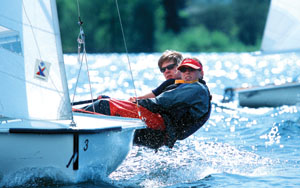
by Shawn
Devine
05/13/2003
Members of the UW Sailing Club have their
sights and sails set on the national championships on Lake Michigan, June
2-10, after blowing past Western Washington University, the University of
Oregon and Portland State at the district regatta. The UW swept each of
the three divisions — co-ed, women’s and team racing — qualifying 10
individuals for national competition. “We’ve been the strongest
team in the district for a long time,” said Andy Schmidt, who will be
skippering the UW’s top co-ed boat at the national regatta.
With no
competitive team and only four members, the UW’s sailing program had all
but sunk to the bottom of Lake Washington during Schmidt’s freshman year
in 1999-00. However, sailing has come a long way at the University since
he moved to the Northwest from San Francisco five years ago. Today,
the club is thriving and competing at the national level, despite the fact
that there is no coach, and, like most club sports at the UW, limited
funding.
The team received $1,500 from the UW Department of
Recreation Sports, an amount that paid for three sets of new sails. To
cover the cost of other expenses, such as travel and lodging, the student
sailors rely on support from the Seattle Yacht Club and fund-raisers such
as the annual alumni regatta. “It’s really hard being a student-run
team,” Schmidt said. “Instead of focusing on racing, like varsity teams
are able too, we must also focus on fund-raising.” Collegiate
sailing is huge on the East Coast, with fully funded varsity teams such as
Harvard, Yale and the University of Connecticut scattered among the top
20.
Part of the reason schools from the East dominate is
proximity. Schmidt noted that schools in the East have easier
access to one another and “typically have to drive a minimum of two hours
to a regatta.” West Coast participants, however, are starting to
show some flash in the Intercollegiate Sailing Association (ICSA), with
teams such as Stanford and USC ranked in the top 10. Like many
schools back East, Stanford and USC have fully funded varsity
programs.
It doesn’t stop competitive sailors at the UW from
performing in a unique sport that allows men and women to compete
together. There is no division strictly for men, although there is a
women’s division. A single competitive boat consists of two
sailors: the skipper and the crew. Schmidt sails with Erin Harkins as the
crew. Often at practice, members will switch teams, hoping to find
better chemistry that leads to a faster boat. A skipper must be poised and
in charge, and the crew must be willing to follow orders and anticipate
the captain’s tactics, while possessing the confidence to disagree when
necessary. “It’s important to communicate with each other really
efficiently,” said Katie Paciotti, who will be the skipper in the women’s
division at nationals. “There is a lot to talk about out there, and if you
don’t get along, there can be problems.” Teamwork is essential to
successful sailing, because the skipper can only do as much as the crew
can do, said club-member Justin Cross. “They work as a team and get
into a groove,” Cross said. “They are totally in sync.”
This is
obvious as the teams perform a maneuver called a “roll tack,” the
discipline of which would probably impress the cadets at West Point. The
skipper and crew rock the boat to one side, causing it to list more than
45 degrees. Then, in unison, they duck under the sail as the skipper
transfers control of the rudder from one hand to the other, making the
boat turn sharply. Not only must the members know one another, they
must also know the wind. There is a three-minute period before the race
starts when boats jockey for position as they “read” the wind, in search
of “clean” air. A whistle is blown in intervals to tell the six
boats how much time remains before the start of the race. About 30 seconds
before the final whistle, the boats line up, fighting for the best spots
through the starting gate, which is marked by two buoys. Because
the boats travel at about six miles per hour, it is hard to call this a
“race,” though it feels a lot faster out in a boat skimming over the
water, Cross said. The layout of the course varies, depending on
the race. Typically, boats will travel along a straight path — upwind —
toward a distant buoy. They make a hard turn and head in the opposite
direction — downwind — toward another buoy. After rounding the second
buoy, they head for the starting gate, located roughly in the middle of
the course, to finish the race.
While most students at the UW are
racing to finish their classes this June, the UW Sailing Club will be
racing to the finish line in hopes of improving on last year’s 13th-place
finish in co-ed racing, out of the 18 entrants at nationals. “I
think we’re going to do really well this year (at nationals) — we have a
lot of boat speed,” Schmidt said. Anticipating his next comment,
Harkins finishes the thought: “We’re just fast.”
Commodores' Report/Index
Big Cats Don't Right
A Word About Instructors
Dining on the Water
Nautical Quotes
Jen's Greek Journal
Day Sailor Fleet News
UW Sailing Club in The
Daily New Year's Trip Report
Rascal's Shakedown
What's Wrong With This Picture?