 505
Sailing– The vang in a breeze by Paul Shipley
505
Sailing– The vang in a breeze by Paul Shipley
505
Sailing– The vang in a breeze by Paul Shipley
How to use the vang in higher winds is a question that I’ve gotten a few times, and this time I figured I’d put it all in writing so that I would at least show some consistency. Note that all of this is from my perspective as a 505 sailor, so first of all take it with a grain of salt (since it’s me) and second of all realize that it may not apply directly to your favorite boat (since your favorite boat may not be a 505).
Upwind
The two theories on how to vang a boat upwind in a breeze are exactly opposite, one family says to increase vang as the wind picks up, and the other says to ease the vang as the wind picks up.
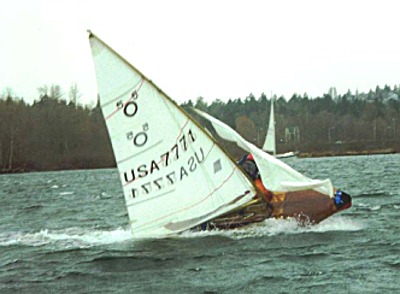 Vang the snot out of the main
as the wind builds
Vang the snot out of the main
as the wind builds
The reasoning behind this theory is that as you vang hard, you bend the mast from the middle of the mast up. This stretches out the luff curve of your sail, making it flatter, resulting in less power. The flatter sail is much more efficient in higher winds where it is more important to reduce drag as there is already plenty of lift and power in the sail. By cracking off a bit and playing the main such that the boom stays just inside the leeward transom corner the boat will start planing upwind. As you notice that you are not carrying the full sail (i.e. there is a wrinkle in the luff) you increase the vang until you can carry the whole sail.
The disadvantage of this approach is that you are also powering up the top of the sail. The top of the sail causes the boat to be heeled more than the bottom half (think of it as a lever) so you are getting a lower drive to heeling force ratio out of it. Vanging also makes the boom lower, making it harder to tack and more likely that as you sheet out in a puff the boom will dip in the water, causing an embarrassing session on the centerboard. On the good side it makes sheeting easier though.
Ease the vang as the wind picks up
This is the exact opposite of the last theory. The reason that it works is that the top third of the sail twists off and provides little heeling force (or drive for that matter). Now that the bottom 2/3 of the sail is doing all of the driving, you get a much better lift to heeling force ratio (again, think of a lever). This effect is especially noticeable when it is starting to blow like stink.
The disadvantages of this approach is that the top third of your sail can begin to rag using this approach, causing the sail to wear out and that top batten to fall out. Also, this causes the boom to lift, making it harder to sheet since now the mainsheet is trying to pull the boom down as well as in. This will wear the driver out in no time.
My pet theory
What I do is as the breeze picks up I vang until I feel overpowered, then I rake the mast a bit, and repeat this until my boom is approaching the point where it won’t clear the tanks. Then I start easing the vang as I rake back. This has the effect of keeping the sheeting angle good and twisting off the top of the sail. This is, of course, harder to do in a boat where you adjust rake on the beach. In that case you have to make an educated guess on shore as to how much rake you need to have once on the water, or return to shore to make the adjustment. Mast rake is complicated enough that it deserves another article so I won’t get into it here.
Reaching
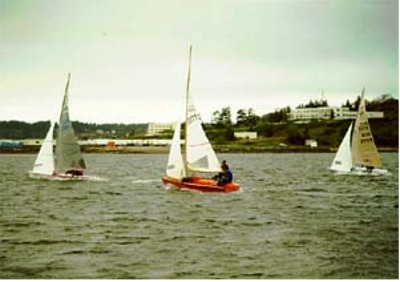 Reaching is easy. As soon as
it gets windy the vang acts as a throttle.
Reaching is easy. As soon as
it gets windy the vang acts as a throttle.
I vang on until I feel a little overpowered, then ease the vang a touch. As the wind changes I keep playing the vang so that I stay just on the happy side of in control. Play around with this first by taking a nice 15 kt. day and stick a friendly and forgiving crew on the wire. Crack off to a beam reach with the board up a bit. Pass the mainsheet to your crew and have them play it while you fiddle with the vang and the tiller. By passing off the mainsheet you get to focus on the vang, and blame the crew when you go swimming. This all works just as well with the kite up, and is important in keeping the boat sailing fast and well balanced.
If you are interested in sailing the 505, and more detail about how the different controls should be used in the boat, check out the International 505 web site at http://www.int505.org. There is also a fairly strong local 505 fleet, for more information about racing the 505 locally see the northwest 505 web site at http://www.geocities.com/nw505. Hope to see you all on the water!
Cover
page Summer SNC
Officers/Chiefs 505
Sailing Rich Passage
UW Sailing
Team Report Victoria Day
Calendar Casting
Bronze Tattle Tale
Notes
to Self Baltic Sailing