
Casting a Bronze Bow Roller
by Chris MehlinChris Mehlin is the owner of Solla Sollew, a Cheoy Lee 27, with an active interest in all things keelboat.
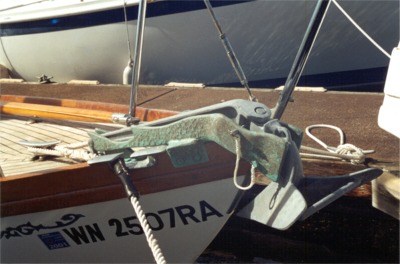 Having
an anchor ready to deploy in an instant is an important piece of safety gear –
a 15 pound CQR released from a bow roller recently saved a storm-battered
Ariadne from the beach, and one can envision other, less dire uses, as when the
engine dies just as one motors behind the breakwater at a marina. The bow roller
is a great way to store a plow anchor (like a CQR or Bruce) which is too bulky
and unwieldy to jam into a cockpit locker, and combined with a hawsepipe through
the deck to a chain locker below provides for fast and easy anchor deployment
and retrieval. When looking for a roller to mount on Solla Sollew, a 1967 Cheoy
Lee Offshore 27, I couldn’t find anything which wouldn’t look out of place.
Bow rollers are almost universally stamped from stainless steel sheet and have a
urethane roller, giving them a pretty modern, high-tech appearance. In addition,
I couldn’t find a roller which had the features I wanted: I wanted one to hold
and release a 25 pound CQR with the pull of a pin, and it had to have a bail
(something to keep the line from hopping out of the roller) which was removable,
plus it had to get over a three-inch toerail. All this led me to cast my own bow
roller out of silicon bronze, a project about which I naively thought “how
hard could it be?”…
Having
an anchor ready to deploy in an instant is an important piece of safety gear –
a 15 pound CQR released from a bow roller recently saved a storm-battered
Ariadne from the beach, and one can envision other, less dire uses, as when the
engine dies just as one motors behind the breakwater at a marina. The bow roller
is a great way to store a plow anchor (like a CQR or Bruce) which is too bulky
and unwieldy to jam into a cockpit locker, and combined with a hawsepipe through
the deck to a chain locker below provides for fast and easy anchor deployment
and retrieval. When looking for a roller to mount on Solla Sollew, a 1967 Cheoy
Lee Offshore 27, I couldn’t find anything which wouldn’t look out of place.
Bow rollers are almost universally stamped from stainless steel sheet and have a
urethane roller, giving them a pretty modern, high-tech appearance. In addition,
I couldn’t find a roller which had the features I wanted: I wanted one to hold
and release a 25 pound CQR with the pull of a pin, and it had to have a bail
(something to keep the line from hopping out of the roller) which was removable,
plus it had to get over a three-inch toerail. All this led me to cast my own bow
roller out of silicon bronze, a project about which I naively thought “how
hard could it be?”…
The particular process I used to cast this roller is called investment or lost-wax casting. The idea is fairly simple: one takes a wax positive (something which looks just like what you want to make) and entombs it in a plaster/sand slurry called the investment. After the investment hardens, this entire thing is put into a big oven and the wax is melted out, then molten bronze is poured into the remaining cavity. After the bronze cools, the investment is smashed and the bronze piece is removed. I did this project at the Pratt Art Institute, in the Central District near the old Wonderbread factory. Pratt is an impressive facility, with complete setups for glassblowing, welding, forging, and casting. They offer evening classes in all these areas, and I took an Introduction to Bronze Casting class, taught by Mark Walker. Once you take a class, you’re typically free to use the equipment you’ve been trained on outside of their classes – a big bonus.
Step One: Measure, Measure, Measure
The roller I wanted to make had a number of critical dimensions and angles. This was especially true because I wanted the anchor to lock in place securely when stowed – boats have been sunk by anchors clattering out of their rollers, gouging a hole in the hull while underway. The design I made hooks over the hoop at the end of the anchor. The anchor has to be slid back slightly to unlock it, something which the removable pin prevents. Also, the roller had to both bolt to the deck and to the toerail, stick out enough so the anchor could seat properly, etc., etc. This is all made more complex by the fact that bronze shrinks as it cools, so the wax positive has to be slightly larger than the desired final dimensions. So I measured, calculated, second-guessed, re-measured, recalculated, redesigned – again and again and again…
Step Two: The Wooden Pattern
Although one can jump right in and make a wax directly, microcrystalline wax is somewhat difficult to work with. Plus, since it gets destroyed in the casting process, if you just make a wax then there is no way to cast replicates – one has to start all over. Typically, then, one starts with a wooden positive, making a mould of this (out of plaster or rubber) in which to cast the wax.
This can be a little complex, as one has to be able to remove the wooden piece from the cast without destroying it or the cast – and one has to be able to remove the wax later. The trick is to cast it in multiple pieces. This bow roller was cast in a total of nine different pieces – two for the main body, one for the roller, three for the toerail clamp and backing plate, and three for the rear bolt plate and backing plate. The patterns were made out of wood and Bondo (yes – the same stuff as is used for cars – works great!). This allows for making nice, smooth curves and filleted corners.
Step Three: The Wax
I made plaster casts of these wooden patterns, and used those casts to make the parts out of wax. All these parts could then be joined together with a hot soldering iron. The basement became a total disaster – first of plaster, which I used about a hundred (!) pounds of, then of wax, which I melted in an old crock pot. I am still scraping up plaster and wax. It was at this stage that I added the fish scales, by pressing a hot butter knife into the surface. In order to get the molten metal to the wax piece, one must create channels to let in the metal and let out the hot gasses. This is done by soldering on pieces of sprue wax – lengths of wax about ½ by ½ inch. One makes what looks essentially like an upside-down tree of wax, with all the parts one wants to cast at the ends of the branches. Everything in wax now will end up in bronze later – it is critical that the wax be as perfect as you can get it!
Step Four: Investing
One makes a large drum out of chickenwire and tarpaper and fills it with a mixture of plaster and sand. My drum stood about four feet tall. One stands next to the drum, holding the upside-down wax tree so the base of it pokes just above the top of the investment. All this happens very quickly – several people work together, mixing up investment and pouring it in. This particular investment took nine pickle buckets full of plaster and sand to fill. This stuff hardens quickly, which is good because you get pretty tired of holding your wax, and then the tarpaper is pulled off and the investment is flipped upside-down in a large kiln, where the wax is burned out.
Step Five: Casting
Once you have an investment all ready to go, it is flipped back so the hole is on the top and then buried in sand to within a few inches of the top. The sand prevents catastrophe in the event that the investment splits when the bronze is poured in. Molten bronze is then poured in and allowed to cool, then the investment is smashed open.
And you’re only halfway done!
When people first told me that after extracting my piece from the investment the job was not near done, I didn’t believe them. I do now. What emerged from the investment still required an immense amount of work. First, all the sprues had to be cut off, then all the flashing and “berries” (little imperfections from cracks and bubbles in the investment) had to be removed, the thing had to be assembled… it is a lot of dirty grinding and hammering and welding. And since you’re working in metal now, it’s pretty slow going.
The cost of the project was about two hundred dollars in metal, wood, plaster, Bondo, drill bits, etc. The class fee was about twice that. It took about two months of pretty solid effort. If I was going to do it again, I’d probably forego the wooden pattern step, as this isn’t the kind of thing I’m likely to make more than one of. I was taking a class, though, and wanted the “full experience.” The roller is mounted with six 7/16 inch bronze bolts and weighs over forty pounds, so it’s probably overconstructed. I also installed a hawsepipe, the hardest part of which was emotional: drilling a 3 ½ inch hole in the deck (I HATE drilling holes in boats!).
Was it worth it? Well in terms of effort it probably took more than was warranted by the need for a bow roller. In terms of cash, I suspect that boat owners have probably parted with this line of reasoning long ago: even the sheet stainless bow rollers cost hundreds of dollars (to say nothing of the anchor, rode, etc.). Six hundred bucks for a bow roller? Not worth it. Six hundred to learn how to cast bronze and get a bow roller besides? Maybe. This is, however, the best improvement I’ve ever made to the boat. I used it extensively while cruising recently in the Gulf Islands, and it made anchoring a breeze. And while I haven’t yet had to do an emergency deployment, it IS nice to know that it is always ready.
Cover
page Summer SNC
Officers/Chiefs 505
Sailing Rich Passage
UW Sailing
Team Report Victoria Day
Calendar Casting
Bronze Tattle Tale
Notes
to Self Baltic Sailing