
Bottom Painting Tips Chris Mehlin of Solla Sollew
While painting the bottom of Solla Sollew, I had the good fortune to be next to a guy who normally worked professionally at Seaview but was moonlighting as a sub-contractor over the weekend. He will remain nameless, as Seaview frowns on its employees taking on work like this, but I found him to be a treasure-trove of useful tips.
1) Painting in the rain. As rain is nearly inevitable here, the time will come when you’re painting the bottom in the rain. I was halfway through constructing an elaborate and pathetic plastic tent around the boat when I was shown that all that was really needed is a little tape “gutter” to direct water flowing down the hull away from the area you’re painting. You need some wide silver tape (super all weather tape – looks like duct tape but is NOT. Other tape won’t work or will leave a mess when you try to pull it off). Fold the tape over, sticky side to sticky side, leaving just about a quarter inch of the sticky part jutting out. Stick it to the hull just above the bootstripe like a little skirt, and put it all the way around the boat. Stick down the top of the tape really well, and it will direct rivulets away from your fresh paint.
2) The merits of having an extended handle on the roller are well known, but this handle should only be about three feet long. Any longer and it just gets in the way.
3) Beware of boats painted with sanding-free primer. This is primarily done when boats are new, as prep for their first coat of bottom paint. The stuff doesn’t work, though, and years later all the bottom paint will start to “alligator” and require laborious removal – often with a chisel.
4) Contrary to what you might read in books, those white, plastic roller tray liners will resist the solvents in bottom paint. As a bonus, the pattern on the rolling surface helps the paint to go on evenly.
5) The going rate for subcontractor bottom painting is $20/hr. They earn every cent (except, of course, when they’re just hanging out drinking beers with the guy working on the adjacent boat).
6) Have some fairing compound handy – there will inevitably be a few gouges, and its easy to fill them then and there. The quick-dry epoxy kind seems favored. I’ve read (Good Old Boat , 1991, Casey) that you should dry these areas with a hairdryer first.
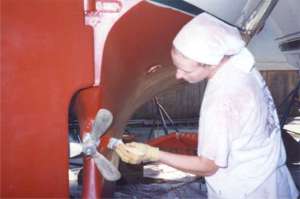 7) Get the areas with a brush that the roller won’t be able to reach before
starting work with the roller.
7) Get the areas with a brush that the roller won’t be able to reach before
starting work with the roller.
8) Apply the paint heavily with the roller, up-and-down, tipping it with the roller into the area you just painted. (One gallon of paint was good for one coat on a 27-foot boat.)
9) Never leave a roller-furling jib in place when a boat gets hauled. The majority of boats falling off their jacks at Seaview have done so when wind unfurled their jibs and caused them to “sail” off. I don’t think that Seaview will allow you to leave these in place now. That said, boats almost never fall off the jacks.
10) Buffing the topsides will be infinitely easier now than it will be when the boat is back in the water. This guy recommended this 3M combination restorer and wax which seemed to work really well. It is important to have a heavy-duty buffer, though. Note that those $20 ones sold for cars do NOT work well. It has to have a really beefy motor.
11) All boats get covered with this strange, gray/black yard filth while hauled. It is not a cause for concern. I suspect it’s the fine dust from all the refinishing going on. Although it is very difficult to remove, if you just ignore it it will go away in a week or two. Very mysterious – I heard of one yard worker who won $100 from an outraged yacht owner who insisted that his boat needed buffing after a week in a yard, where it has gathered this grime. The worker bet him that it’d be gone in two weeks – and it was. As was mine. It does mean, however, that you should resist the temptation to buff the deck, coachroof, etc. while the boat is hauled.
12) If you don’t have fineline tape, or you don’t want to pay obscene prices for it, strapping tape can be used instead (I have not tried this – caveat emptor!). On this same vein, note that if you’re doing the bottom paint and bootstripe you’ll need at least three kinds of tape: fineline for sharp edges, silver for the rain skirt, and easy-lift for painting next to freshly painted surfaces.
13) I have repeatedly heard that cayenne pepper added to bottom paint makes it work better, although I’ve not yet seen a real test of the theory. Conrad Johnson of Copasetic recommends 4oz/gallon (Why Didn’t I Think of That? Roberts, 1997). I tried a bit on part of Solla Sollew’s bottom – let you know how it worked on the next haulout!
14) I found a heavy-duty, random-orbit sander to work really well for prep. If you hook it up to a shop-vac for dust collection, most yards (Seaview included) will let you work without tenting the boat. And it’s a lot neater. A setup like this will pay for itself very quickly. I used a 6-inch Porter-Cable with a shop-vac dust collector – it was awesome! The guy who worked at Seaview said that it was only slightly less good than the pneumatic ones he works with professionally. Buy sanding disks in rolls of 100.
Further, more obvious tips:
15) Paint the bottom in a color which contrasts that of the previous year – this will make it clearer when the new paint is worn off.
16) Don’t forget to save some paint for the areas where the jack screw pads rested – you’ll need to get these just before the boat goes back in the water. Never back off a screw in an effort to paint under the pad!
17) I feel compelled to mention safety a bit more: a real respirator is required, both for sanding and painting. The former requires a particulate filter, the latter an organic vapor filter – often you can get combination cartridges. Paper masks do NOT work. I saw a whole family of people at Seaview working with shirts tied over their mouths!
Bottom painting is a miserable job, but it is so expensive to have a yard do the job that it becomes pretty hard not to do it yourself. An added bonus is that you have some idea that the job was done right – prep work is everything, and the yards have an economic disincentive to do more prep work than is essential. Plus the owner can attend to other things as well: regreasing sea cocks, polishing the prop, checking the cutlass bearing, etc. That said, most yards probably do a better job than the do-it-yourselfers do, as they have the right tools. Which makes doing the job yourself a grand excuse for getting the right tools!
Front Page CrewList WYC Memories Skipper Ratings Eye Splice Crew Choice Bottom Paint Unflattering Photos
Rotating Masts
Mentoring
Program WYC Events Calendar
Bylaws Amendment