
Rotating Masts John Courter
Most beach catamarans have rotating masts. Rotating masts improve performance by reducing turbulence on the mainsail. They can also be used to control how much power is available from the mainsail.
The mast is made to swivel by the construction of the mast step and the
placement of the attachment points of the forestay and shrouds. The mast step is
a ball or a cup and the bottom of the mast is the opposite to mate with it. The
shrouds and forestay attach to a single point on the front of the mast. If the
shrouds were attached to the side of the mast as they normally would be they
would tend to hold the mast lined up fore and aft with the boat. The Hobie 16
has stops built into the mast step to limit the rotation of the mast and
therefore the amount of rotation is fixed. The Hobie 21 and the sx18 have a U
shaped bar sticking out behind the mast just above the boom. The end of the bar
has a line that runs to a cleat on the boom. How much line is let out determines
how much the mast is allowed to rotate. With both systems the mast automatically
rotates to the same setting on the other tack after a tack or jibe. This assumes
that when you tack you ease the mainsheet as you normally would, as it is
possible hold the mast rotated the wrong way if the mainsheet is left tight.
(Usually the blocks on the boom for the mainsheet are mounted slightly aft to
push the boom forward to facilitate rotating the mast.)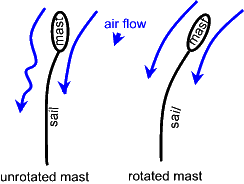
Masts that do not rotate have an area of disturbed air behind them which causes the mainsail near the mast to not be effective in generating lift. A mast that can be rotated is allowed to rotate until the leeward side of the mast continues the smooth curve of the sail eliminating the disturbed air on the leeward side. There is still disturbed air on the windward side of the mainsail but this increase in disturbed air on the windward side is not nearly as much a loss in lift as the gains made by cleaning up the air flow on the leeward side.
Typically a good starting point for setting the rotation of the mast with an adjustable rotator for upwind sailing is to point the rotator bar at the shroud when the sail is sheeted in. If you have the sail set with a deeper camber for more power you would allow the mast to rotate more, for a flatter sail a little less. Check it by lying down on the tramp face up and sight up the mast on the leeward side. For sailing downwind, that is a beam reach apparent wind, you would rotate the mast as far as possible. In light wind with little sheet tension the boom is not being pushed forward and if the shrouds are tight, the leeward shroud will limit mast rotation as the side of the mast runs into the shroud. To force the mast to rotate there is another control on the sx18. It consists of a U shaped bar on the front of the mast with a shock cord led through a bail at the front. The shock cord is led around either side of the mast and the two ends attach to a line leading to a cleat on the boom. The distance from the front of the bail to the cleat is greater when the boom is lined up with the mast than when the mast is allowed to rotate, so when the shock cord is tensioned it will pull the boom forward and hold the mast in rotation.
The Hobie 16 with its fixed stops is only set correctly for one point of sail. Class rules allow you to file the stops down to alter what fixed point you believe is best.
An additional adjustment one can make with an adjustable rotating mast is to de-power the mainsail. These masts are long in fore-aft plane and narrow side to side. With the rotation set to the minimum to look like part of the sail, the orientation of the mast is to have mostly the long dimension in line with the sail, and therefore the loads on the mast trying to bend it in the plane in which it is stiffest. This results in little bend, keeping the sail fuller and more powerful. If you allow the mast to rotate 90 degrees relative to the sail, to put the narrow dimension of the mast in line with the loads, the mast will bend and flatten the sail, de-powering it. The diamond wire on the side of the mast that is now pointing forward will come tight and limit the bend. The loosest you would set the diamond wires would be to keep the mast from breaking. On the sx18 the diamond wires can be as loose as being able to touch the wires to the mast 3 feet up from their lower attachment point when the mast is unloaded.
Front Page CrewList WYC Memories Skipper Ratings Eye Splice Crew Choice Bottom Paint Unflattering Photos
Rotating Masts
Mentoring
Program WYC Events Calendar
Bylaws Amendment