
Selecting Crew or How to be Chosen as Crew Rebecca Linde
Those who know me know that I have sailed with crew on both ends of the spectrum. There have been crew who I dream and scheme of the next adventure with. On the other side were those who came perilously close to being left at sea.
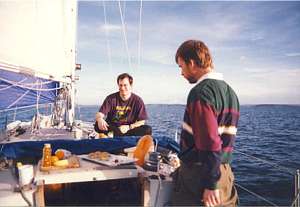 Is there such a thing as
perfect crew? For me, it would be the crew from the "Frosted Crab"
voyage. We were five people on a 34-foot boat for a week in December. To some
that might sound cold and crowded, to me it is what all crews should aspire to.
Not everyone on the crew was particularly experienced, but all were ready to
learn and pitch in wherever needed. Cooking, doing dishes, taking watch,
whipping lines, fixing the compass light, pulling up the anchor and generally
participating in the cruise, not waiting to be told what to do. The trip was not
without adversity; we battled rats (and won), faced icy docks, and came against
"Mad Crabbers" (and lost). The quick
Is there such a thing as
perfect crew? For me, it would be the crew from the "Frosted Crab"
voyage. We were five people on a 34-foot boat for a week in December. To some
that might sound cold and crowded, to me it is what all crews should aspire to.
Not everyone on the crew was particularly experienced, but all were ready to
learn and pitch in wherever needed. Cooking, doing dishes, taking watch,
whipping lines, fixing the compass light, pulling up the anchor and generally
participating in the cruise, not waiting to be told what to do. The trip was not
without adversity; we battled rats (and won), faced icy docks, and came against
"Mad Crabbers" (and lost). The quick
thinking and actions of the crew reduced all these perils to nothing more than
"all in the day of a sailor". Now that's a good crew.
For those that never got asked back. The crew who sat around waiting for
someone to serve them a drink generally underfoot or not to be found when there
was a job to be done. The crew who "knew too much" to pay attention to
instructions. The crew who engaged in illegal activities or specifically went
against the skipper's wishes. The crew who just tried to stay out of the way and
did not care to learn, basically there for the cruise, and maybe served drinks
instead of waiting to be served. Those who demonstrated their inability to learn
or follow instructions.
"Steer so that we pass that buoy to the left". Five minutes later, and
every 5 minutes until relieved of the helm, "Why are we pointed at the
reef? We need to pass that buoy to the left".
Get the picture? So where do you find good crew? I want to go sailing for a long weekend, how can I make sure we all have a chance for a good time?
In our sailing club there are often more people wanting to go on a cruise
than there is space on the boats. Often the majority of the berths are given to
those who have sailed with the skipper previously. In part this is because
skippers want people who know their boat and are better equipped to help run
things with less instruction. Once you have sailed with someone, you have an
idea of how they will interact with the boat and crew. The second day of a
weeklong trip is the wrong time to find out about your crew's annoying habit of
laziness or stupidity. How to get a foot in the door, or a chance at a
berth? Get to know the skippers off the water. Attend social functions, small
boat or other club events, take a keelboat class. Express your interest in
cruising. Hopefully you will get an invitation to go for an afternoon sail.
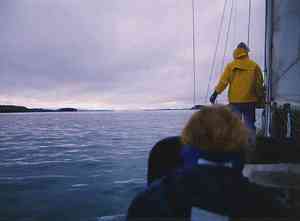 A three or four hour sail is
a nice opportunity to get to know your skipper and show off your good qualities.
Take a turn at the helm. Ask for help when you are not sure how something will
work. Keep busy as long as there are things to do, lines to tidy up, a jib to
skirt, keep a lookout for other boat traffic. Remember to relax and enjoy the
sail, too. Once the work is done, there is time to enjoy the company of the
crew. Lastly, stick around to help tidy up after the sail is over.
A three or four hour sail is
a nice opportunity to get to know your skipper and show off your good qualities.
Take a turn at the helm. Ask for help when you are not sure how something will
work. Keep busy as long as there are things to do, lines to tidy up, a jib to
skirt, keep a lookout for other boat traffic. Remember to relax and enjoy the
sail, too. Once the work is done, there is time to enjoy the company of the
crew. Lastly, stick around to help tidy up after the sail is over.
If your trip will encompass a mealtime, check with the skipper, ahead of time,
about plans for food. Will you be sailing to a destination to disembark and eat
at a restaurant? You will need to bring money. If you are to eat on the boat,
ask what you can bring. Offer to help prepare or clean up after the meal when
the time comes. If no meal is planned, offer to bring a snack to share. Ask if
you should bring drinking water, do not assume it will be available. Keep a
couple of Powerbars or granola bars in your gear bag, just in case.
Sometimes sailing trips take longer
than expected, the mood will be better if you don't add hunger to the scene.
Sailing gear does not have to cost you the equivalent of a quarter's tuition,
but you do need clothing appropriate to the expected conditions. In Seattle,
rain is always an expected condition. A $20 rain suit (pants and jacket) will do
just fine. I used my raingear from hiking for my first years of cruising. For
cool weather trips wool or fleece are appropriate. Cotton once wet, will suck
the heat right out of you, soon relieving you of your usefulness as crew. People
have been left at home on the dock because they did not have appropriate attire.
If you are not sure what to bring, ask your skipper before the day of departure.
What makes a good skipper? Because the crew will take their lead from the
skipper, it is important to set a good example. No one wants to sail with
Captain Bligh. Be sure to give a review of the boat systems and rules before
leaving the dock. Where gear should be stowed, how to use the head, rules for
smoking, life jackets and alcohol. Is there food and water available? Should the
crew help themselves or ask first? Where the emergency equipment, flares, first
aid, and bilge pumps are. How to use the radio. Establish the pecking
order. This may be obvious for those who have sailed together before, but those
new to the boat may not know who to take orders from. Typically I will simply
point out a "First Mate", and tell the crew to follow their
instructions. Then I will arrange so that one of us (Skipper or First Mate) is
always available above decks. Time to leave the dock. Give clear
instructions to each crewmember as to what their job is and when to do it.
During the sail help the crew to do new tasks on the boat, raising and trimming
sails, how to navigate, how to steer, and other skills according to the
interests of the crew. Take the time to find out the crews sailing history. They
may already have good skills that you can take advantage of.
Sailing is fun. A little effort up front will help assure smooth sailing along
the way. New crew, new friends, new adventures...
Front Page CrewList WYC Memories Skipper Ratings Eye Splice Crew Choice Bottom Paint Unflattering Photos
Rotating Masts
Mentoring
Program WYC Events Calendar
Bylaws Amendment